Aqua tables Pacifico again after study reveals conditional water service
Aqua WSC confirmed that its board tabled Item 13 and did not approve proposed Resolution 26.08.02 on August 4. The open-record production shows that Garver reports existing supply and firm pumping below the capacity ratios cited in its revised study; even Pacifico's developer-supplied 14-gpm peak request depends on new Watterson wells and treatment, a pump station, storage and approximately 2.5 miles of approach main. It also contains materially different February and May layouts: the superseded concept shows two large data-center buildings and a compact power block, while the later plan shows four narrower buildings—two marked future—and a lengthened generation block. Neither provides a complete MW schedule, so 710 MW of generation and approximately 490 MW of IT load remain JETI full-buildout figures rather than capacities verified by the drawings.
The Board did not approve Pacifico's request—and the detailed record is more conditional than “water is feasible” suggests.
On August 4, Aqua WSC's Board voted to table Item 13, proposed Resolution 26.08.02. Aqua's own posted packet is marked DRAFT and TABLED, and its signature lines are blank. The newly obtained supporting record also shows that Garver's revised study evaluated only the developer's current 14-gpm peak request—not the full water demand of the proposed data center and power plant—and made even that limited service contingent on major capital projects.
This was the second tabling—not a denial and not an approval.
The June and August actions concern two different proposed resolutions. In June, staff required a revised data-center feasibility study. In August, the revised study returned and the Board tabled the request again. Aqua has not yet posted approved August minutes, so the official record does not disclose the motion maker, seconder, vote tally or stated reason. Aqua has since scheduled discussion and possible action for September 1 as Item 6 under Resolution 26.09.01.
Item 14 / Resolution 26.06.05 is tabled for a revised study.
Garver completes the capacity and hydraulic memorandum.
Item 13 / Resolution 26.08.02 is not approved.
Resolution 26.09.01 and the proposed agreement are not publicly available.
An independent attendee separately reported that a tabling motion was made, seconded and passed by majority after residents asked for more time. Those procedural details remain attendee-reported until Aqua publishes approved minutes. Read the attendee account ↗
Aqua cannot serve even this limited request from the existing system as-is.
Garver's existing-system table reports supply and firm pumping below the capacity ratios the study cites as TCEQ requirements. Adding Pacifico's requested service barely changes the existing shortfall, which means Pacifico did not create it. But Aqua would be making another service commitment before the public record shows when every prerequisite will be operating.
| Measure | Study benchmark | Existing | With Pacifico |
|---|---|---|---|
| Supply | 0.60 gpm / connection | 0.39 | 0.39 |
| Firm pumping | 1.00 gpm / connection | 0.32 | 0.31 |
| Total storage | 200 gal / connection | 254 | 246 |
| Elevated storage | 100 gal / connection | 108 | 104 |
The study says supply and pumping are below TCEQ requirements. The packet does not discuss waivers, alternative criteria or any other regulatory basis that might change that conclusion.
Four major pieces of infrastructure
- New supplyAt least 3,000 gpm of Watterson wells and corresponding treatment.
- New pumpingA Watterson station with three new 6,000-gpm pumps.
- New storageOne new one-million-gallon ground-storage tank.
- New connection13,340 feet—about 2.53 miles—of approach main.
Public records show Watterson groundwater permits advanced in 2023, completion deadlines were extended in 2024 and Aqua awarded drilling of Watterson 1 and 2 in April 2025. They do not establish that the wells are producing or supply a common in-service date for treatment, the pump station, storage tank and approach main.
The revised study models Pacifico's request. It does not calculate the campus's water demand.
Garver evaluates 23 living-unit equivalents, 9 gpm maximum-day demand and 14 gpm peak-hour demand supplied by the developer. It does not provide a full-campus water balance for data-center cooling, power-plant operations, turbine washing, construction, fire-water replenishment, drought conditions, wastewater or phased buildout.
- 23
- living-unit equivalents requested
- 14 gpm
- modeled peak-hour demand
- 0
- fire flow in Aqua's model
- 2,841
- acres listed in the Aqua application
Conditional hydraulic feasibility for one narrowly defined Aqua connection after specified improvements.
What it does not supportPresent capacity, a verified full-campus demand, or overall water feasibility for the data center and power plant.
The project was materially redesigned between February and May.
Aqua's open-record production contains two genuinely different concept plans. The earlier February sheet appears in a 23-page file explicitly titled Superseded Feasibility Study. A later May Kimley-Horn sheet appears in the revised 19-page production. The building geometry, power-generation arrangement and accompanying water assumptions all changed. Neither sheet is a final approved construction plan.
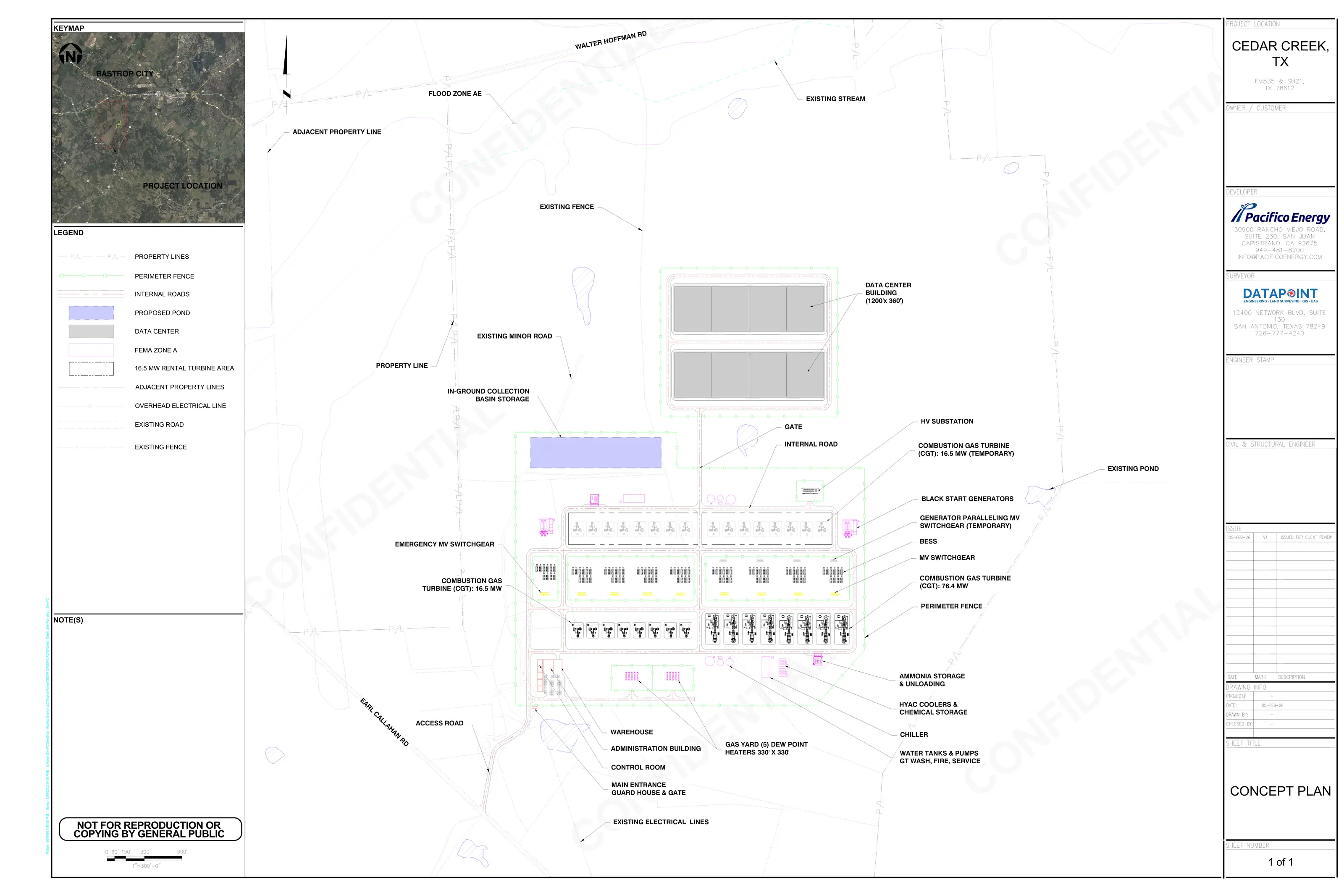
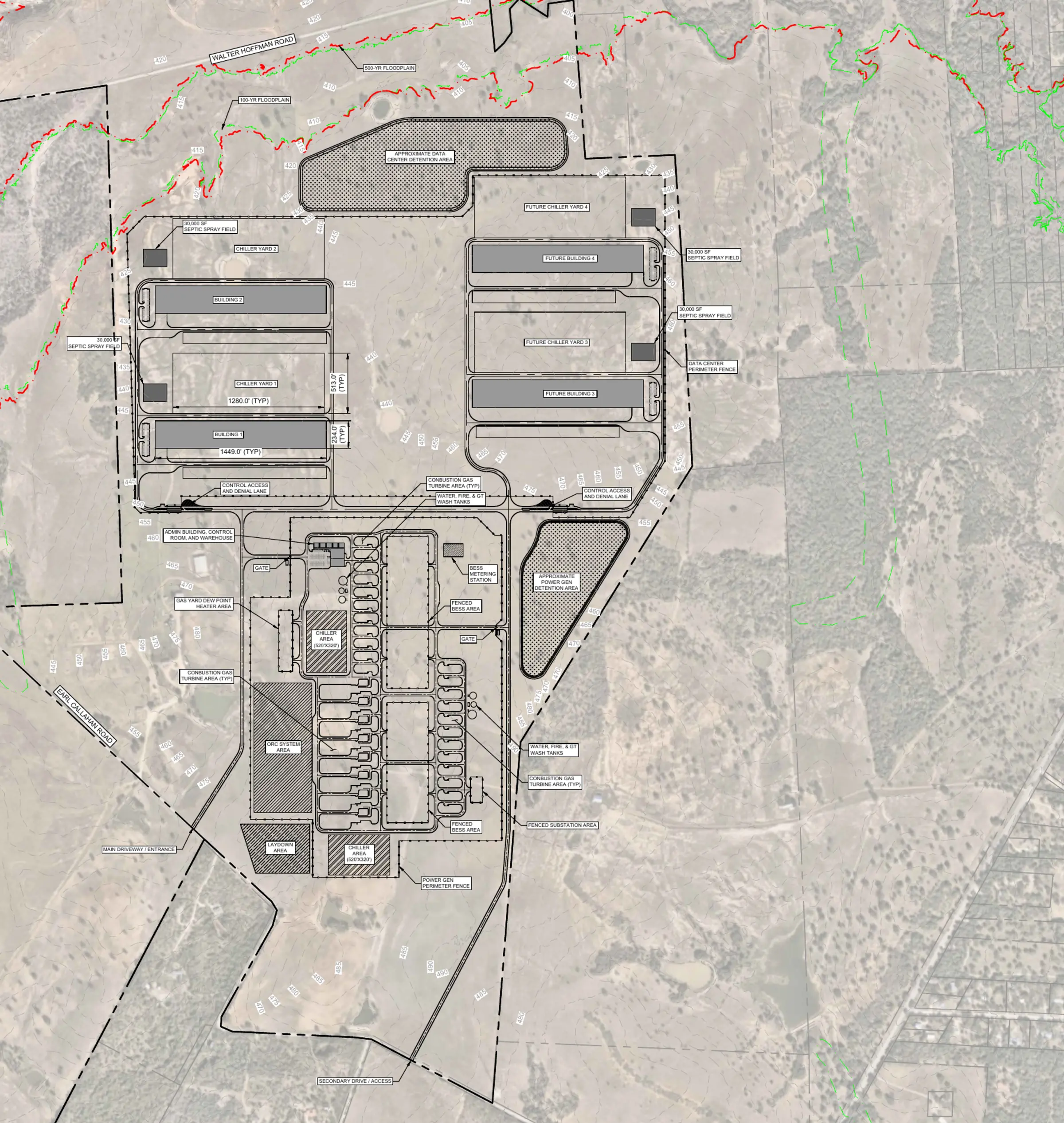
The February sheet is stamped “CONFIDENTIAL,” “Issued for Client Review” and “Not for reproduction or copying by general public.” Those markings are preserved in the image released through Aqua's open-records response. The May sheet is also expressly conceptual and says it was prepared without a final survey, topography, utility information or governmental coordination.
| Feature | Earlier record | Later record |
|---|---|---|
| Plan date and status | February 5 client-review concept in a packet titled “Superseded” | May conceptual master plan in the revised production |
| Data-center arrangement | Two buildings, each labeled 1,200 × 360 feet | Four buildings, each approximately 1,449 × 234 feet; Buildings 3 and 4 are marked future |
| Power-generation arrangement | Compact east-west block with 16.5 MW temporary and 76.4 MW turbine labels | Longer north-south block with repeated turbine areas, BESS, ORC and substation, but no unit ratings |
| Water modeled in accompanying study | 75 LUEs; 30 gpm maximum day; 45 gpm peak hour; plus a 250 gpm fire-tank fill rate for 16 hours | 23 LUEs; 9 gpm maximum day; 14 gpm peak hour; zero Aqua fire flow |
| Hydraulic consequence | Existing infrastructure could not maintain required pressure during fire-tank filling; the study required the approach main, two additional trunk-main segments, Watterson facilities and a 1.5-million-gallon elevated tank | The reduced request works hydraulically with the approach main, but service remains contingent on Watterson wells and treatment, pumping and a one-million-gallon ground tank because existing capacity ratios remain deficient |
The application fields and engineering calculations do not use the same peak-hour numbers: the earlier application lists 35 gpm while Garver models 45; the revised application lists 12 gpm while Garver models 14. The comparison above uses the engineer's modeled values.
The later drawing is a redesign—not proof that the earlier plan was merely Phase 1.
The strongest reading is that the May sheet replaced the February concept for the currently drawn development core. Within the May plan itself, Buildings 1 and 2 appear to form an initial stage and Buildings 3 and 4 a later stage. But neither plan supplies a formal phase schedule, turbine schedule or MW allocation, and neither is a complete master plan for all 2,841 acres.
The accompanying water request also shrank sharply: 75 to 23 LUEs and 45 to 14 gpm peak-hour demand, while the 250 gpm fire-tank refill scenario disappeared from Aqua's model. The revised study is therefore a materially narrower feasibility test—not evidence that Aqua solved the earlier, higher-demand scenario.
The later concept shows a coordinated, phased development core.
Its drawing path identifies “BLACKCHAMBER DC BASTROP,” while the sheet name combines “CEDAR CREEK DC & PG.” Separate fences and controlled entrances suggest distinct operations; shared roads, drainage and coordinated geometry show integrated physical planning. That does not, by itself, establish common legal ownership.
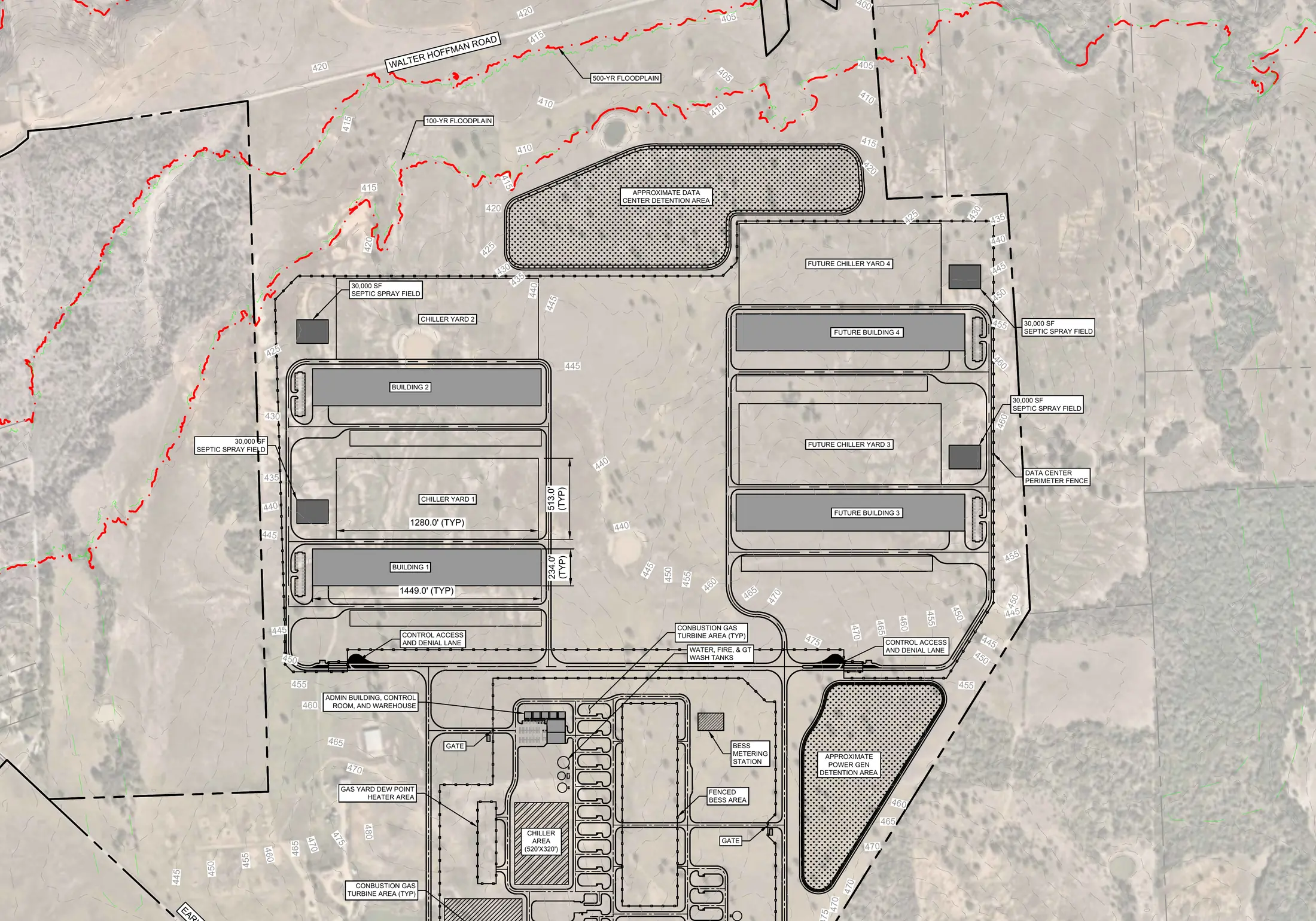
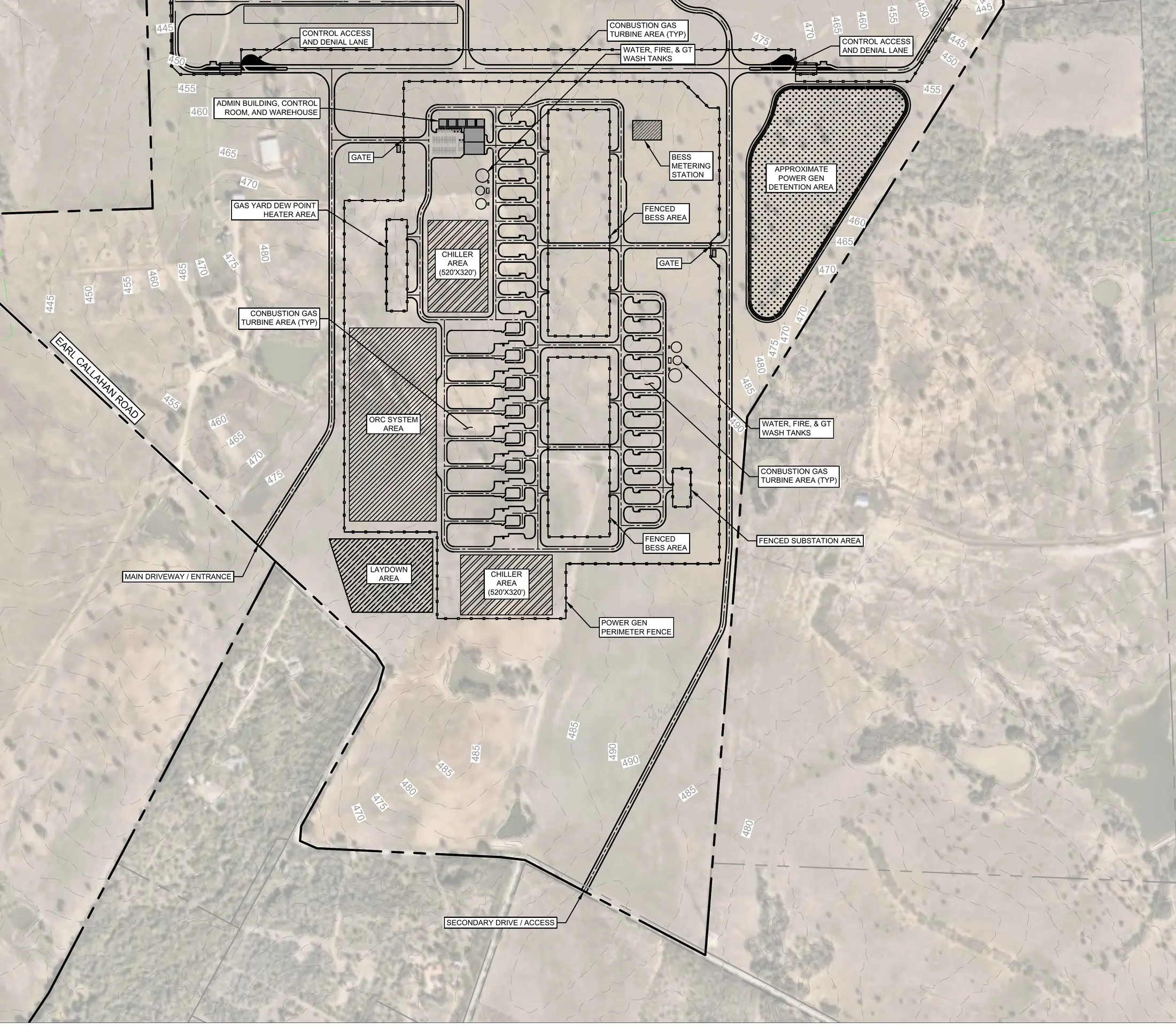
The detailed figures above reproduce only the May sheet. They help read that later concept; they are not final construction drawings.
The clearest published footprint is about 16.8% of the stated acreage.
The plan itself does not give a total developed-acreage figure. The strongest cross-check is the two active construction-stormwater records already identified for the shared B&W Ranch site: 304 acres for Black Chamber's data-center footprint and 173.54 acres for Pacifico's power footprint. Together they total 477.54 acres.
This does not mean the remaining land will stay open or undisturbed. It may serve as buffer, future expansion, infrastructure or another use. The May drawing is a concept for the present development core—not an ultimate land-use plan for every acre.
They are consistent with the filed scale, but they do not prove it.
Pacifico's JETI application and Supplement 1 identify 710 MW of site-rated generation and approximately 490 MW of associated IT load as full-buildout figures. The February sheet labels 16.5 MW temporary and 76.4 MW turbine classes, while the May sheet omits unit ratings. Neither supplies a complete MW schedule, turbine models, electrical one-line or building load allocation. The May generation block may be the full current concept and its four data-center buildings may collectively represent the stated IT load, but those remain interpretations until an equipment and load schedule is published.
Site-rated generation stated in the incentive filing.
Associated IT load stated in the incentive filing.
Visible equipment classes and geometry do not verify total capacity.
The detailed packet answers the layout question—and sharpens several others.
No all-source campus balance
Cooling, construction, turbine washing, annual use, drought and phased demand are not reconciled.
No replacement fire-water design
The application removes Aqua fire flow in favor of an onsite pond, while the plan labels tanks and detention without documenting emergency reserve or refill.
No complete CIP delivery plan
The packet does not give a common in-service date, current completion status or a clear split between Aqua and developer costs.
The records do not align on their face
Aqua's letter says no part of the property is in a special flood-hazard area, while the supporting plan depicts 100- and 500-year floodplain boundaries. The parcel and panel scope need reconciliation.
Lost Pines Watch's earlier support guidance was wrong. The current Action Center has been revised for August 13 and later meetings.
See every current action and meetingCore sources and document note
Aqua's public website currently posts a 12-page packet that confirms the August 4 tabling. The February overview comes from page 3 of a separate 23-page Aqua production labeled “Superseded Feasibility Study.” The May overview and two detailed crops come from page 7 of a revised 19-page production. Aqua supplied both files through an open-records response. Plan measurements and the count of apparent turbine positions are labeled interpretations, not developer-certified equipment quantities.
Get urgent local alerts without relying on social feeds.
Join for meaningful meeting, permit, record, and decision updates. This is a focused local list, not a daily newsletter.