
Privacy-safe county data show 2,247 anonymous residential sites within two miles and 5,701 within three. The corrected register maps 25 school, childcare and learning-program entries within four miles of the filed perimeter, including 17 within about three miles. Co-located programs count separately; the map labels each entry’s verification status.
Anchor investigation · CC-001
Pacifico Cedar Creek
A proposed 48-turbine natural-gas generation facility whose August air application states 1,326 MW of maximum nominal output, evaluated here alongside the earlier JETI and emerging FM 535 corridor records.
Content reviewed October 1, 2026 · Evidence dates appear with the records.
Site-suitability conclusion
This project should seek another location
The conclusion is about this site—not a claim that no large power project could ever be built responsibly. A 1,326 MW, 48-turbine proposal requires an industrial setting with adequate buffers, emergency capacity, water, access, and a complete permitting record.
The region has experienced severe drought and the 2011 Bastrop Complex and 2015 Hidden Pines fires. The map’s drought layer displays the latest available weekly source dates. Industrial-fire capability remains unverified.
The air application states 1,326 MW of maximum nominal output. An earlier JETI filing described 710 MW of site-rated redundant power supporting roughly 490 MW of IT load; the released record does not reconcile those measures.
What a more suitable site would demonstrate before approval
- Substantial separation from homes, schools, and childcare.
- Verified fire-water, apparatus, staffing, mutual aid, and evacuation capacity for the full buildout.
- A sustainable water source tested against drought and cumulative demand.
- Full major-source and aggregation analysis for every turbine, generator, and related operation.
- Road, pipeline, transmission, noise, lighting, and drainage infrastructure suited to continuous industrial use.
New records · August 9
A formal TCEQ challenge is pending—and both authorizations remain active
Two amended motions ask TCEQ to review and stay Pacifico's and Black Chamber's construction-stormwater authorizations. TCEQ has not stayed or overturned either record, and the motions' allegations are not agency findings.
Likely data-center developerTXR1551YV
Black Chamber Partners
BCG Cedar Creek Campus · 304 acresBlack Chamber is the construction-stormwater operator for the data-center-named footprint and publicly describes its business as digital-infrastructure development. The hyperscale customer or tenant remains undisclosed.
Power-side operatorTXR1565YW
Pacifico CCK Energy 1
B&W Ranch · 173.54 acresA dedicated Pacifico entity holds construction-stormwater coverage for the generation footprint. It registered in Texas one day before the reported county grading and abatement filings.
Official verification
Open TCEQ Central RegistryUse TCEQ's search
TCEQ's internal detail pages are not durable public permalinks and can return “page does not exist” when opened from a shared link, so copy and paste the Program ID numbers instead.
- Open Central Registry (CR) Query.
- Choose Program ID Search.
- Enter either authorization number below.
Black Chamber Partners
TXR1551YVPacifico CCK Energy 1
TXR1565YWShared regulated site
RN102987831Developer due diligence
Separate Pacifico projects clarify what Cedar Creek still needs
These are not evidence of Cedar Creek impacts or outcomes. They are clearly labeled comparisons that identify records and decision questions local reviewers should require here.
Primary TCEQ comparisonSeparate Pecos County project
GW Ranch has a full public air record
35 simple-cycle turbines in the TCEQ summaryPacifico's separate GW Ranch record names turbine groups, operating assumptions, controls, startup and shutdown allowances, and pollutant-specific emissions. That is the level of project-specific disclosure still missing for Cedar Creek.
Independent record reviewSeparate Hood County project
Fort Spunky turned on water-source certainty
Concept plan revoked; litigation pending when reportedThe Texas Tribune reports that Hood County revoked the separate Pacifico-affiliated project's concept plan after its proposed utility water source fell through. Pacifico sued the county. That does not decide Cedar Creek, but it makes a definitive water source and clear local authority essential before approval.
Read the public-record investigationProject timeline
The filings are advancing on parallel tracks
Corporate formation, water engineering, county applications, school-tax incentives, and construction-stormwater coverage have moved in a coordinated sequence. Labels distinguish completed public-record events from future dates that remain estimates.
- Government relations
Pacifico retains a Texas lobbyist
Texas Ethics Commission disclosures identify Pacifico Energy as a client of Austin lobbyist Jay P. Brown beginning in 2025 and continuing in 2026.
- Ohio alternative
No application filed before the moratorium
Muhlenberg Township minutes say Pacifico requested blank zoning and variance forms but submitted nothing. Three weeks later, trustees imposed a one-year data-center moratorium.
- Corporate structure
Pacifico Cedar Creek Holdco registers
A new Texas holding company appears. Its exact ownership and financing role are not disclosed in the public account-status record.
- Water
Aqua tables large-volume service
Aqua WSC’s board does not approve Pacifico’s request. Staff requires a revised feasibility study after identifying the development as a data center.
- Corporate and county filings
Power operator forms; grading and abatements follow
Pacifico CCK Energy 1 registers on June 17. Local reporting says the county received two grading applications and two tax-abatement applications the next day.
- School-tax incentive
Pacifico signs JETI application J0049
The filing seeks a school-tax limitation for the power facility and describes the adjacent computing load, pending permits, economics, and competing-site claim.
- Construction stormwater
Black Chamber coverage becomes active
TXR1551YV identifies Black Chamber Partners as operator for the 304-acre BCG Cedar Creek Campus. An approved Notice of Change follows the next day; its changed fields are not public.
- JETI supplement
Pacifico formally separates the JETI scope
Supplement 1 limits qualified investment to the power facility and describes the data center as unrelated and third-party-owned, while retaining the generation-and-load relationship.
- Construction stormwater
Pacifico power-side coverage becomes active
TXR1565YW identifies Pacifico CCK Energy 1 as operator for 173.54 acres of planned disturbance at the same B&W Ranch regulated site.
- Stormwater procedure
Two amended motions ask TCEQ to review and stay both authorizations
TCEQ indexes the Motions to Overturn under Pacifico's TXR1565YW. They also seek review of Black Chamber's TXR1551YV. Both authorizations remain active; no stay or Commission order is posted, and the filings' assertions are not agency findings.
- County policy
Signed countywide abatement policy adopted
The official signed record confirms adoption for a two-year term and marks Commissioner Mark Meuth absent. This made the County eligible to consider abatements; it did not approve Pacifico's individual applications.
- Water-service decision
Aqua places possible approval on its agenda
Official Agenda Item 13 schedules discussion and action on approving large-volume service through Resolution No. 26.08.02. The posted agenda does not attach the revised feasibility study or resolution.
- Water-service outcome
Aqua tables the request a second time
Aqua confirms that its Board voted to table Item 13 / Resolution 26.08.02. The posted packet is marked DRAFT and TABLED, its signature lines are blank, and it did not identify a return date. Aqua later scheduled discussion and possible action for September 1.
- County-authority outcome
Commissioners Court tables Item E.4
After strong resident testimony and written comments challenged the draft's narrow account of county authority, the Court did not adopt it. This was not a Pacifico-specific denial, permit, moratorium, or abatement vote.
- JETI Supplement 2
Equipment categories added; core design details still missing
The 16-page filing adds an eligible-equipment list and a generic site-selection graphic while repeating most of Supplement 1. It does not supply turbine counts or models, a final layout, operating profile, emissions or noise modeling, complete water and fire plans, or the data-center power arrangement.
- Immediate air and water action
TCEQ enters a final-package cycle; Aqua schedules September 1 consideration
TCEQ still lists Air Registration 185019 as pending after closing a deficiency cycle and opening a Final Package Rework Cycle on August 26. Aqua's September 1 agenda separately schedules Pacifico's Large Volume Water Service request as Item 6; Resolution 26.09.01 and the proposed agreement are not publicly available.
- Filed estimate—not a start notice
Both operators estimate construction mobilization
Black Chamber lists September 1 and Pacifico September 30. These are estimated dates in stormwater filings, not proof that grading or construction has begun.
Why there are now two supplementsMore pages. The same connected project—and many of the same unknowns.
The original J0049 application and both supplements remain useful historical records. Open this section to see what each filing changed and what it left unresolved.
Read section
More pages. The same connected project—and many of the same unknowns.
The original J0049 application and both supplements remain useful historical records. Open this section to see what each filing changed and what it left unresolved.
Pacifico filed J0049 in June, Supplement 1 on July 16, and Supplement 2 in August. Supplement 1 revised scope, maps, excluded improvements, the competing-site narrative, and the economic model. Supplement 2 adds equipment categories and a generic development graphic but repeats most earlier pages. None replaces the original; all three must be read together.
The JETI project is generation only
Pacifico said its qualified project consisted solely of the natural-gas generation facility. It excluded all data-center assets, buildings, operations, investment, and property.
Supplement 1, page 3The data center was described as unrelated
Pacifico said a third party would own, finance, develop, and operate the adjacent data center, with no Pacifico ownership or operational control.
Supplement 1, page 3The scale relationship remains
The earlier JETI filing pairs 710 MW of site-rated redundant power with approximately 490 MW of IT load. The later air application states 1,326 MW of maximum nominal output. The differing measures remain unreconciled in the released record.
Trace this finding →Equipment categories are not a final design
Pacifico named turbines, gas compressors, cooling, transformers, switchgear, controls, tanks, pumps, and interconnection equipment. Counts, models, placement, operating hours, emissions, noise, water, fire, and emergency details were not supplied in the JETI record.
Read Supplement 2Methane-fired generation at community scale
The technology is industrial. The surrounding land use is residential.
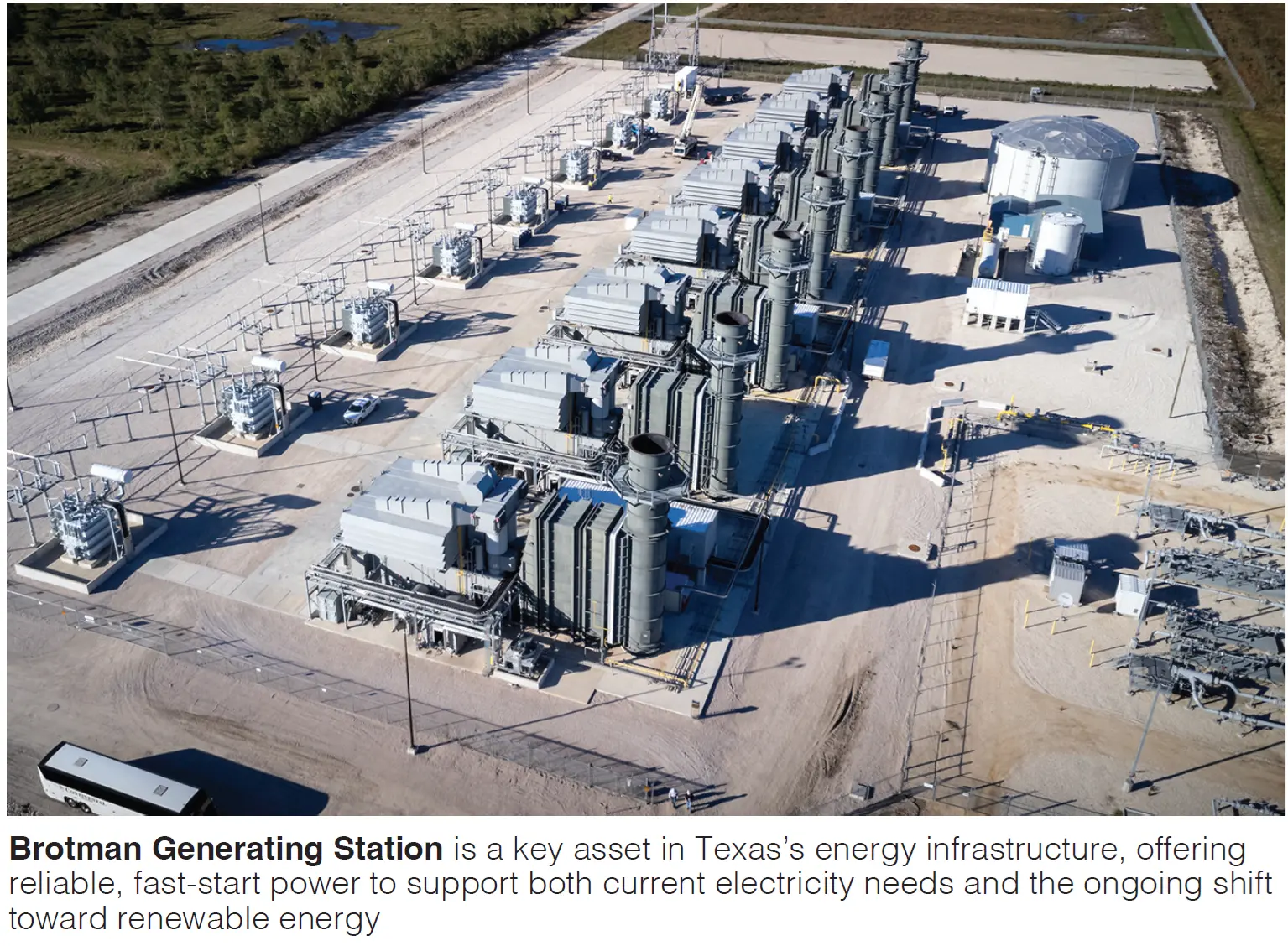
Natural gas is composed primarily of methane. Pacifico's air application identifies 48 simple-cycle turbines across six model families and states 1,326 MW of maximum nominal output, together with fuel-gas compressors, air-cooled equipment, transformers, switchgear, tanks and emissions controls. That equipment creates siting questions that cannot be answered by calling natural gas “clean” or by considering each permit in isolation.
Combustion controls reduce pollution; they do not eliminate it.
EPA identifies nitrogen oxides and carbon monoxide as primary gas-turbine pollutants, with volatile organic compounds, hazardous air pollutants and particulate matter also possible. Nitrogen oxides and VOCs also help form ground-level ozone. EPA associates elevated NO₂ with airway irritation and worsened asthma, particle pollution with heart and lung effects, and ozone with airway inflammation and asthma attacks. With homes, schools and childcare close to the filed perimeter, the public needs the actual emissions inventory, operating hours, stack data and dispersion modeling—not technology labels.
A daytime sound check cannot represent an around-the-clock plant.

Turbine inlets and exhausts, compressors, cooling fans, transformers and other rotating equipment create broadband, tonal and low-frequency sound. DOE materials specifically flag high levels of low-frequency noise as a gas-turbine concern in data-center energy systems. If the plant follows a constant hyperscale computing load, nearby receptors could experience persistent nighttime operation; Pacifico’s actual duty cycle remains unfiled. A receptor-by-receptor study must cover normal operation, starts, shutdowns and emergencies.
The hazard is larger than a flame at the turbine.
The proposed system adds high-volume methane delivery and compression, hot turbine enclosures and exhausts, lubricating oils, transformers, switchgear and other ignition or fuel sources. NFPA maintains a dedicated power-plant fire-protection standard for hazards of this kind. In severe drought and a wildfire-affected landscape, approval should require a project-specific hazard analysis, leak detection, fixed suppression, fire-water calculations, apparatus access, evacuation analysis and verified local mutual-aid capability.
Simple-cycle generation rejects a large amount of heat.
In a simple-cycle turbine, high-temperature exhaust is not routed through a steam bottoming cycle to make additional electricity. EPA says turbine exhaust remains several hundred degrees, and EIA reports simple-cycle systems use substantially more fuel per unit of electricity than combined-cycle plants. Pacifico also lists air-cooled fin-fan equipment and Organic Rankine Cycle units, but their final configuration is unknown. This does not prove a particular off-site temperature increase; it does require quantified heat-rejection, exhaust-plume and summer microclimate analysis before siting the plant beside an existing community.
“Peaking” equipment does not answer how the full campus will run.
Pacifico describes dedicated, reliable generation supporting approximately 490 MW of IT load, plus fast-start peaking turbines. That makes the missing hourly operating profile critical: residents need to know which units can run, for how long, how often they start, what happens during grid or equipment failures, and how the plant combines with backup generators and other corridor sources. Health, noise, heat and emergency impacts must be modeled cumulatively for the maximum reasonably foreseeable buildout.
Project record
What is filed—and what each number means
Applicant figures are reported as applicant figures. Filing status is not operational status.
- Applicants named in filings
- Pacifico CCK Energy 1 LLC (air) / Pacifico Cedar Creek LLC (JETI)
- Filed site
- 382 Earl Callahan Road, Cedar Creek, Texas
- Generation
- 1,326 MW maximum nominal output in the air application
- Earlier JETI power figure
- 710 MW site-rated redundant power
- Associated IT load
- Approximately 490 MW
- Investment
- $2.237 billion in the revised consultant model
- Permanent jobs
- 25 applicant-projected positions
- Starting payroll
- About $3.5M, down from about $6.2M
- Property
- Narrative says ~2,842 acres; listed parcels total ~2,810
- Construction operators
- Black Chamber Partners · 304 acres; Pacifico CCK Energy 1 · 173.54 acres
- Water service
- Aqua considered the request September 1; LPW reported authorization to negotiate an NSSA under Resolution 26.09.01, which is not publicly available; the prior study models 23 LUEs and a 14-gpm peak with no fire flow
- Local tax-break requests
- Chapter 312 withdrawals confirmed August 19; JETI withdrawal company-reported, with no located Comptroller disposition
- Pipeline screening
- Four mapped transmission corridors cross the listed parcels; exact easements and fuel connection remain unverified
Risk record
Why this location requires a higher evidentiary bar
Each card distinguishes a verified regional condition from a missing project-specific showing.
Wildfire and emergency response
The regional fire history and ESD 1's adopted fire code are verified. The project-specific plan review, fire-water system, apparatus access, industrial-response capability, staffing, and evacuation consequences are not yet public.
Air emissions
The released air application identifies 48 turbines across six model families, modeled schedules, controls and applicant-calculated emissions. Final stack terms, source-wide enforceable limits, monitoring, and TCEQ's written eligibility determination remain unresolved.
Water supply
Aqua’s revised study models only 23 LUEs, a 14-gpm peak, and no fire flow. It does not establish total campus demand, cooling water, annual volume, fire-water supply, the final source mix, or drought terms; the proposed resolution nevertheless says Aqua has capacity to serve a data center.
Noise and lighting
No project-specific public noise study or final layout establishes continuous, startup, shutdown, tonal, or low-frequency impacts at nearby receptors.
Traffic, access, and evacuation
County and TxDOT access approvals were listed as pending. Construction traffic, heavy-haul routes, emergency access, and shared evacuation bottlenecks require cumulative review.
Drainage and land disturbance
Active stormwater coverage identifies 477.54 acres of planned disturbance. Two amended motions now ask TCEQ to review and stay both authorizations, but neither is suspended and the motions' allegations are not agency findings. The required SWP3 maps and county grading and drainage files remain unavailable.
Public finance
The original power-side filing sought 100% Chapter 312 abatements from Bastrop County, ESD No. 1, and ESD No. 3 for 2029–2038, together with a ten-year Bastrop ISD taxable-value limitation. The released filings do not publish a consolidated, reproducible relief total.
Cumulative industrialization
Black Chamber now appears in the public record as construction operator for a 304-acre data-center footprint beside Pacifico’s 173.54-acre power footprint. Power, water, roads, pipelines, and emergency response cannot be assessed in isolation.
Statewide precedent—not a Pacifico allegation
Review the full buildout before local approvals make it a fait accompli.
The Texas Tribune and Floodlight documented Texas projects that first obtained minor air authorizations and later pursued much larger turbine or generator fleets. EPA guidance warns that permit restrictions or project segmentation that do not reflect the planned operation can circumvent major-source preconstruction review.
There is no public evidence in this record that Pacifico has already used that tactic. The lesson is procedural: the county should require one full-buildout account of every turbine, generator, stack, operating scenario, affiliated facility, and co-located load before tax abatements, grading, or other discretionary approvals move ahead.
JETI decision standardJETI application J0049: withdrawn, according to Pacifico.
Pacifico says it withdrew its single Bastrop ISD JETI application. The Comptroller’s public project list no longer includes J0049, and no JETI agreement was approved; however, the former detail page does not post a withdrawal notice or effective date. The supplements were revisions to this one application.
Read section
JETI application J0049: withdrawn, according to Pacifico.
Pacifico says it withdrew its single Bastrop ISD JETI application. The Comptroller’s public project list no longer includes J0049, and no JETI agreement was approved; however, the former detail page does not post a withdrawal notice or effective date. The supplements were revisions to this one application.
Status distinction
One JETI application; two separate county abatements
Bastrop County confirms that Pacifico Cedar Creek LLC and Bevo Chamber LLC formally withdrew two Chapter 312 applications on August 19. No County abatement agreements were approved and no County incentives were granted. That official County action is separate from Pacifico’s statement that it also withdrew JETI J0049.
§403.609(b)(3) remained in force
Had J0049 advanced, the failed SB 2322 proposal could not have been treated as an enacted exemption for dispatchable generation.
Read the statuteThe power-side filing sought local and school-tax relief
The original filing sought 100% Chapter 312 abatements from Bastrop County, ESD No. 1, and ESD No. 3 for 2029–2038, together with a ten-year Bastrop ISD taxable-value limitation. The released filings do not publish a consolidated, reproducible relief total. No County abatement was approved; County records confirm the Chapter 312 withdrawals, while Pacifico says it also withdrew JETI J0049.
Read the original JETI filingOhio had no filed zoning application
Township minutes say Pacifico requested blank forms but filed nothing before the one-year data-center moratorium.
Read the township recordResearch agenda
Nine questions that can change the case
These are not rhetorical questions. Each names the next record needed.
CriticalTurbines
How will the released 48-unit inventory, rating bases, modeled schedules, and any later project changes be reconciled in the final approval?
Next evidence: Final technical review, approved unit schedule, represented-emissions table, and written capacity reconciliation
CriticalAir
Stack heights, locations, exit conditions, annual hours, and modeled receptors?
Next evidence: Final approved stack table, impacts review or modeling files, and enforceable monitoring methodology
CriticalWater
Aqua WSC service, groundwater wells, or a hybrid supply—and what annual demand?
Next evidence: All-source water balance, cooling design, fire-water plan, CIP schedule and completion evidence, final NSSA, fees, and groundwater-district records
CriticalFire
Fire-water storage, pump redundancy, hydrants, apparatus access, and suppression design?
Next evidence: County and fire-jurisdiction plan review
HighSite
Why does the sum of listed parcel acreage differ from the narrative site acreage?
Next evidence: Parcel records, survey exhibits, and boundary GIS
CriticalOwnership
Who is the hyperscale customer, and what affiliate, financing, control, site-development, or exclusivity relationships connect it to Black Chamber and Pacifico?
Next evidence: Owner-agent forms, site-control instruments, contracts, utility studies, financing records, and tenant disclosures
CriticalOfftake
Is there a signed PPA, capacity agreement, term sheet, letter of intent, exclusivity agreement, or reservation?
Next evidence: Non-confidential agreement descriptions and records requests
CriticalJETI
What specific competing-site evidence is confidential, and does any currently actionable alternative exist?
Next evidence: Land, permitting, utility, corporate, and Comptroller records
HighEconomics
Why did starting permanent payroll fall roughly 44% while headcount remained 25?
Next evidence: Underlying wage, occupation, benefits, and escalation assumptions
Primary record
Start with the records
The dossier is a reading layer over the sources—not a substitute for the applications, permits, minutes, and official status reports.
DOC-0001 · June 2026Applicant filing in government record
JETI Application J0049
Original application describing the energy and data-center relationship, project boundary, equipment, permitting status, and modeled economic benefits.
Open sourceDOC-0008 · July 16, 2026Applicant filing in government record
Pacifico Cedar Creek JETI Application Supplement 1
Narrows the JETI project to the gas-generation facility, expands the compelling-factor narrative, identifies the paused Ohio alternative, maps excluded existing improvements, and revises the economic model.
Open sourceDOC-0015 · July 14–18, 2026Primary government database
TCEQ Authorizations TXR1551YV and TXR1565YW
TCEQ records show active construction-stormwater coverage for Black Chamber Partners’ 304-acre BCG Cedar Creek Campus footprint and Pacifico CCK Energy 1’s 173.54-acre power-side footprint at the same regulated site. At the linked Central Registry page, open the CR Query, choose Program ID Search, and enter TXR1551YV or TXR1565YW.
Open sourceDOC-0017 · June 3, 2026Primary utility record
Aqua WSC June 3 Board Minutes
Approved minutes show the board tabled Pacifico Energy Development’s large-volume Zone 2 water-service request after staff identified the development as a data center and required a revised feasibility study.
Open sourceDOC-0022 · January 12, 2026Primary local-government record
Muhlenberg Township January Proceedings
Minutes state that Pacifico requested blank zoning-change and variance forms, had not submitted applications, and did not attend the meeting after being invited.
Open sourceDOC-0023 · February 2, 2026Primary local-government record
Muhlenberg Township February Proceedings
Minutes record adoption of a one-year data-center moratorium following substantial public opposition, making the named Ohio alternative paused and less advanced than the Bastrop site.
Open sourceDOC-0024 · Checked August 9, 2026Primary government status report
TCEQ Pending New Source Review Applications
The updated pending list still contains no publicly identifiable NSR entry under the known Pacifico, Black Chamber, B&W Ranch, CCK, Earl Callahan, or Cedar Creek project identifiers. This does not prove that no pre-application work exists.
Open sourceDOC-0038 · Indexed August 2026Primary agency docket
TCEQ Commissioners’ Action Item 147527 / Docket 2026-0805-WQ
TCEQ indexes a procedural challenge under Pacifico authorization TXR1565YW. Two amended motions received July 20 ask the Commission to review and stay both TXR1565YW and Black Chamber authorization TXR1551YV. The authorizations remain active; no stay or Commission order is posted.
Open sourceDOC-0040 · Effective October 1, 2023Primary emergency-services record
Bastrop County ESD No. 1 Fire Code and Local Amendments
ESD 1 adopted the 2018 International Fire Code and local provisions governing plan review, permits, inspections, fire flow, hydrant distribution, fire-department access, private fire mains, pumps and tanks. Aqua's 'Fire Flow: None' does not establish project compliance with these separate requirements.
Open sourceDOC-0048 · Posted August 12, 2026Applicant filing in government record
Pacifico Cedar Creek JETI Application Supplement 2
Adds an eligible-equipment category list and a generic site-selection graphic while repeating most of Supplement 1. It still omits turbine count and model, final layout, operating schedule, emissions and noise modeling, complete water and fire plans, hazardous-material and battery details, data-center identity, and public comparative economics.
Open sourceDOC-0049 · Status checked October 1, 2026Primary government permit-status record
TCEQ Air New Source Review Project 413471 / Registration 185019
TCEQ’s project record lists Registration 185019 / Project 413471 as PENDING. A deficiency cycle opened September 9 with no completion date shown. The tracking table is an administrative record; it does not supply the underlying correspondence or a final eligibility decision.
Open sourceDOC-0051 · Submitted and received August 14, 2026Applicant filing released in government record
Pacifico Cedar Creek EGU Standard Permit Registration Application
The application identifies 48 natural-gas turbines across six model families and states 1,326 MW of total maximum nominal electrical output; Appendix A's more precise per-model ratings sum to 1,325.76 MW. It reports source-wide emissions, modeled operating schedules and controls while stating that the operating scenarios used for emissions estimation are not intended as limits.
Open sourceDOC-0050 · Accessed August 27, 2026Official meeting agenda
Aqua WSC September 1, 2026 Board Agenda
Item 6 schedules discussion and action on Large Volume Water Service to Pacifico Energy Development LLC through Resolution 26.09.01. Public communication is Item 4 and is limited to three minutes per speaker. The new resolution and proposed agreement are not publicly available.
Open source