
Project watch & community action · October 4, 2026
Pacifico marches on during the pause. Help unlock $12,000 to fight it.
A permit pause has not canceled Pacifico’s plans for Cedar Creek. Its hiring campaign points to a major construction effort. Ask Bastrop City Council to call for a public hearing—and help fund our community’s challenge to the proposed gas plant.
Pacifico is still preparing to move forward.
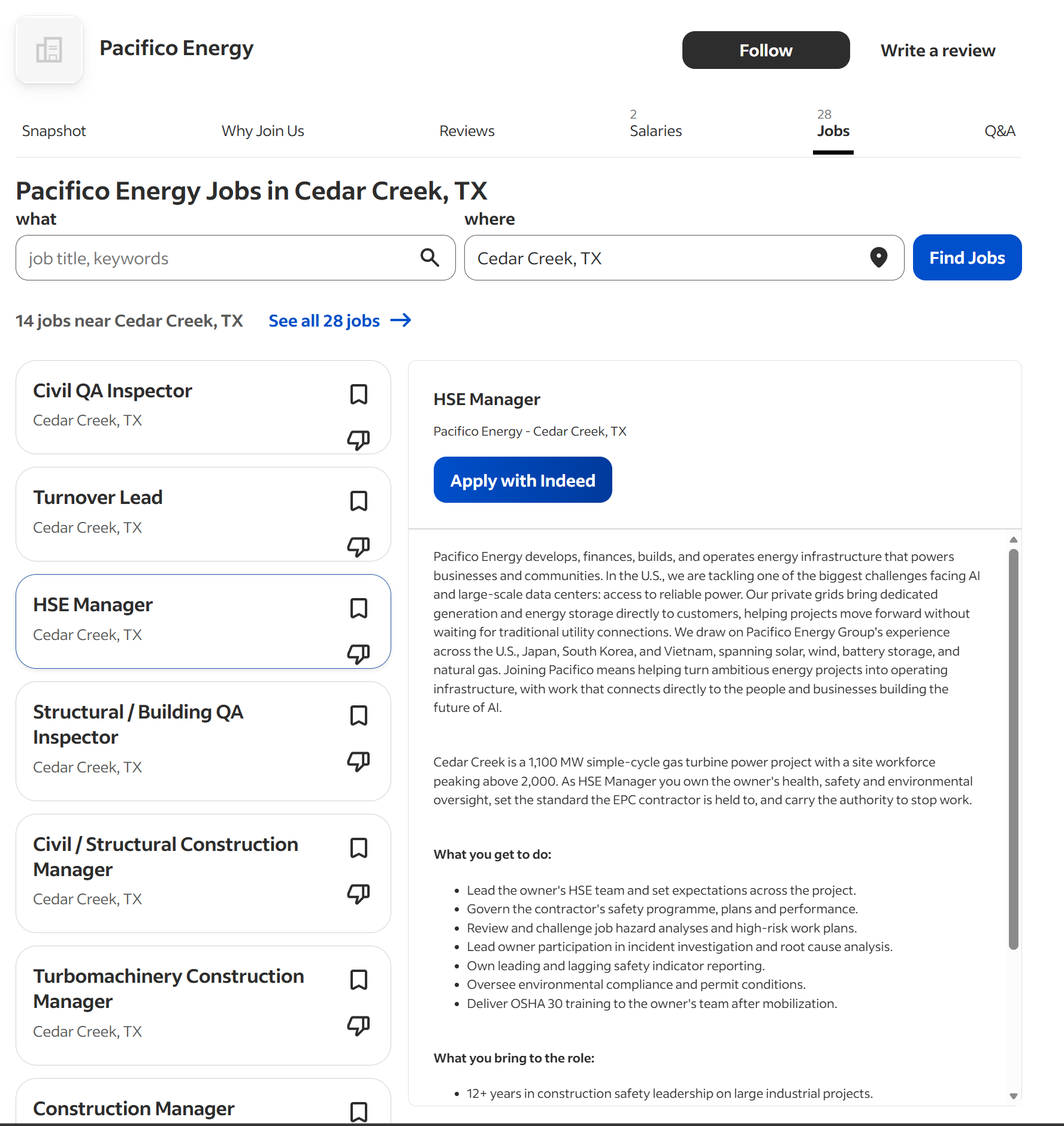
Pacifico Energy is advertising Cedar Creek positions on Indeed, including construction management, quality inspection, and health, safety and environmental oversight. The screenshot shared with Lost Pines Watch shows 14 jobs near Cedar Creek at the time it was captured.
Posting dates: Indeed’s posting data dates the HSE Manager listing to September 30, 2026, and the Electrical Construction Manager and Turbomachinery Construction Manager listings to October 1, 2026. Dates are in Central Time and describe these individual Indeed listings.
Its HSE Manager posting, checked October 4, describes the project this way:
“Cedar Creek is a 1,100 MW simple-cycle gas turbine power project with a site workforce peaking above 2,000.”
That is Pacifico’s description of its plans. Recruitment is evidence of continued preparation. It does not establish that the air permit has been approved, construction has begun, or a start date is settled.
The Governor’s September 21 directive pauses TCEQ permit issuance related to data-center projects pending ERCOT’s review. It does not expressly prohibit recruitment or stop every project activity. Read our explanation of the pause.
A capacity question remains: the job ad’s 1,100 MW figure differs from the 1,326 MW identified in the released air application. An advertisement alone does not establish a revised permit application or lower proposed emissions.
View the Indeed screenshot shared with Lost Pines Watch
What would more than 2,000 workers mean for Cedar Creek?
The posting describes construction oversight and a peak site workforce. It is not a promise of 2,000 permanent jobs for local residents. It also does not say how many workers would be local, how long peak staffing would last, or how shifts and transportation would work.
At that scale, the community needs answers about the pressures construction could put on daily life:
- Traffic and school routes. Worker arrivals and departures, heavy equipment and material deliveries could add traffic. Which roads and entrances would be used? How would shift changes affect school buses, neighborhood access and emergency vehicles?
- Dust, diesel exhaust, noise and lighting. Clearing, earthwork, trucks and equipment need controls, work-hour limits and a way for neighbors to get problems corrected. EPA identifies construction diesel exhaust as a health concern for workers and nearby residents.
- Housing and local services. If substantial numbers of workers come from elsewhere, where would they stay? What demand would fall on rentals, lodging, fire protection and emergency medical services—and who would pay for additional capacity?
- Roads and accountability. Residents need delivery routes, road-condition assessments, repair commitments and a named contact responsible for responding to complaints.
Construction jobs and spending could benefit some local workers and businesses. That does not answer who would carry the costs. The staffing figure alone cannot establish a vehicle-trip count, rent increase or emergency-service shortfall; those require project-specific plans and analysis.
Construction would end. The air-quality question would remain.
If the gas plant is built and operated, its air emissions would continue beyond construction. The concern includes pollutants released by combustion and pollution that forms after emissions enter the atmosphere.
- Nitrogen oxides. Fuel combustion produces nitrogen oxides, or NOx. EPA says elevated nitrogen dioxide exposure can irritate airways and worsen asthma; longer exposure to elevated concentrations may contribute to asthma development. EPA’s NO₂ explanation.
- Ground-level ozone. NOx and volatile organic compounds react in sunlight to form ozone. It can travel beyond the source and affect rural areas. Ozone can inflame airways and aggravate asthma, and long-term exposure is linked to asthma aggravation. How ozone forms · Health effects.
- Fine particles. NOx can also help form particle pollution. Fine particles can enter deep into the lungs, and particle exposure can affect both the lungs and heart. EPA’s particle-pollution explanation.
Children, older adults, people with asthma or other heart and lung conditions, and people active outdoors deserve particular attention. These are established pollution hazards, not a prediction of illness at any particular Cedar Creek home or school.
Actual exposure would depend on the final equipment, operating hours, emission controls, weather, terrain and existing pollution. Annual emissions totals alone do not tell us what people would breathe. Residents need credible analysis of concentrations at homes, schools and other nearby locations, with background pollution included.
Lost Pines Watch continues to press for accurate emissions calculations; enforceable operating-hour limits; monitoring, testing and reporting for pollution controls; and proper treatment of startup and shutdown emissions. Those protections must be demonstrated and enforceable before the community is asked to live with the consequences.
Email and call Monday morning, October 5—before noon.
Ask Bastrop City Council to call for a public hearing.
Send your emails and make your calls to the mayor, council members and city manager Monday morning, October 5. Ask them to put a resolution on the October 13 Council agenda, with city attorney review, calling on TCEQ to hold a formal, on-the-record public hearing before any decision on Pacifico’s gas plant application.
The Council is being asked to support a meaningful opportunity for residents to be heard. This request does not ask the Council to endorse or oppose the project or to make TCEQ’s permit decision.
Act Monday morning to be sure your request arrives in time.
There is uncertainty about the city’s practical cutoff: residents report that council officials have said noon Monday, October 5, while the city’s published seven-calendar-day rule points to noon Tuesday, October 6 for the October 13 meeting. Please send your emails and make your calls Monday morning, before the earlier reported cutoff. The mayor, two council members, or the city manager may place an item on the agenda. Ask for prompt city attorney review and confirmation that the request will be placed on the agenda.
Passing the resolution on October 13 would put the city’s request on record before TCEQ’s October 19 compliance update to the Governor. That update is not an announced deadline for a final Pacifico permit decision.
Prepare an email to City Council
The button opens an editable draft addressed to all seven officials below. Replace the name and community placeholders, add your own concerns, and review it before sending. If an email app does not open, use the sample and contacts below.
Sample email you can personalize
Subject: October 13 agenda request: a public hearing on Pacifico’s gas plant
Email addresses and phone numbers
- Mayor Ishmael Harrisiharris@cityofbastrop.org512-718-5957
- Perry Loweplowe@cityofbastrop.org512-718-6995
- Cynthia Meyercmeyer@cityofbastrop.org512-718-9300
- Kevin Plunkettkplunkett@cityofbastrop.org512-718-5421
- Kerry Fosslerkfossler@cityofbastrop.org512-718-6601
- Mayor Pro Tem John Kirklandjkirkland@cityofbastrop.org512-718-5102
- City Manager Sylvia Carrilloscarrillo@cityofbastrop.org512-332-8800 (City Hall)
Contact details checked October 4 against the city’s Council directory and City Manager page.
We need our community to step up.
Raise $12,000. Unlock another $12,000 for legal fees.
A donor has committed $12,000 toward legal fees, contingent on our community raising a matching $12,000. Meeting that goal would put $24,000 toward legal work to challenge the proposed Pacifico gas plant.
The donor’s commitment depends on us doing our part. Research, public comments and volunteer time matter. A legal challenge also takes money. The pause gives us an opportunity to prepare; it does not fund the work or guarantee the project will stop.
Lost Pines Watch also needs funds now for flyers and signs, public-information requests, and the tools that keep neighbors informed. Those ongoing costs are real, alongside the legal matching goal.
Please contribute what you can today. If you can make a larger gift, this is the time to step forward. Share this update directly with neighbors and people who care about Cedar Creek, and ask them to contribute too. We cannot build a funded community challenge if everyone assumes someone else will pay for it.
Donate to help meet the $12,000 goal
501(c)(3) application pending. Donations made now may be tax-deductible retroactively if the IRS approves Lost Pines Watch’s application with an effective date covering your gift. Deductibility is not yet assured. Please keep your donation receipt. IRS guidance. The $12,000 donor commitment is for legal fees.
Donate now. Bring a neighbor October 20.
Join us at the Lost Pines Watch Town Hall: The Pause, the Permit, and What Happens Next, Tuesday, October 20, 6:30–8:30 p.m., at Lost Pines Pickleball Club. Learn what we know, ask questions, make your voice heard, and help organize the next steps.
Take a step right now: leave a resident comment, add yourself to the opposition map, volunteer for outreach, or join the School Coalition. See all current ways to take action.
If you cannot give right now, help by sharing the donation appeal, volunteering for outreach, and signing up for alerts. Please do not wait until the town hall to help fund the work.
Further reading
Inside the Granbury data center revolt: recalls, lawsuits and Texas Rangers — Fort Worth Star-Telegram, July 17, 2026, republished by Yahoo News.
The article follows residents organizing around Granbury’s proposed Project Patriot power plant and data-center campus through public-records requests, litigation and efforts to strengthen local safeguards. Cedar Creek readers will recognize the questions about transparency, public participation and who bears the impacts of a large industrial project. It offers a useful example of sustained community organizing; Granbury’s city zoning and recall procedures differ from the tools available here. The article describes allegations and ongoing efforts as of July, not a final outcome.
Evidence note: Hiring descriptions and workforce figures are Pacifico’s statements, checked against the supplied screenshot and live HSE Manager posting on October 4. Posting dates come from Indeed’s listing data, checked October 4 and converted to Central Time; they do not establish when Pacifico first began recruiting or exclude earlier advertisements. Potential construction pressures are Lost Pines Watch’s assessment and planning questions; their magnitude has not been established. EPA links explain general pollution hazards, not site-specific exposure forecasts. Match details were supplied by Lost Pines Watch’s organizer.